
Telecom Titan: The Jio Story
The big dawg of telecommunications that took over India's 4G (and now 5G) space, and led a brand new era of digital connectivity. Read all about their upcoming IPO here.

The following article is for educational purposes only. Each and every piece of information used henceforth in this article is sourced from the Draft Redding Herring Prospectus (DRHP) of Jio Platforms Limited.
Introduction
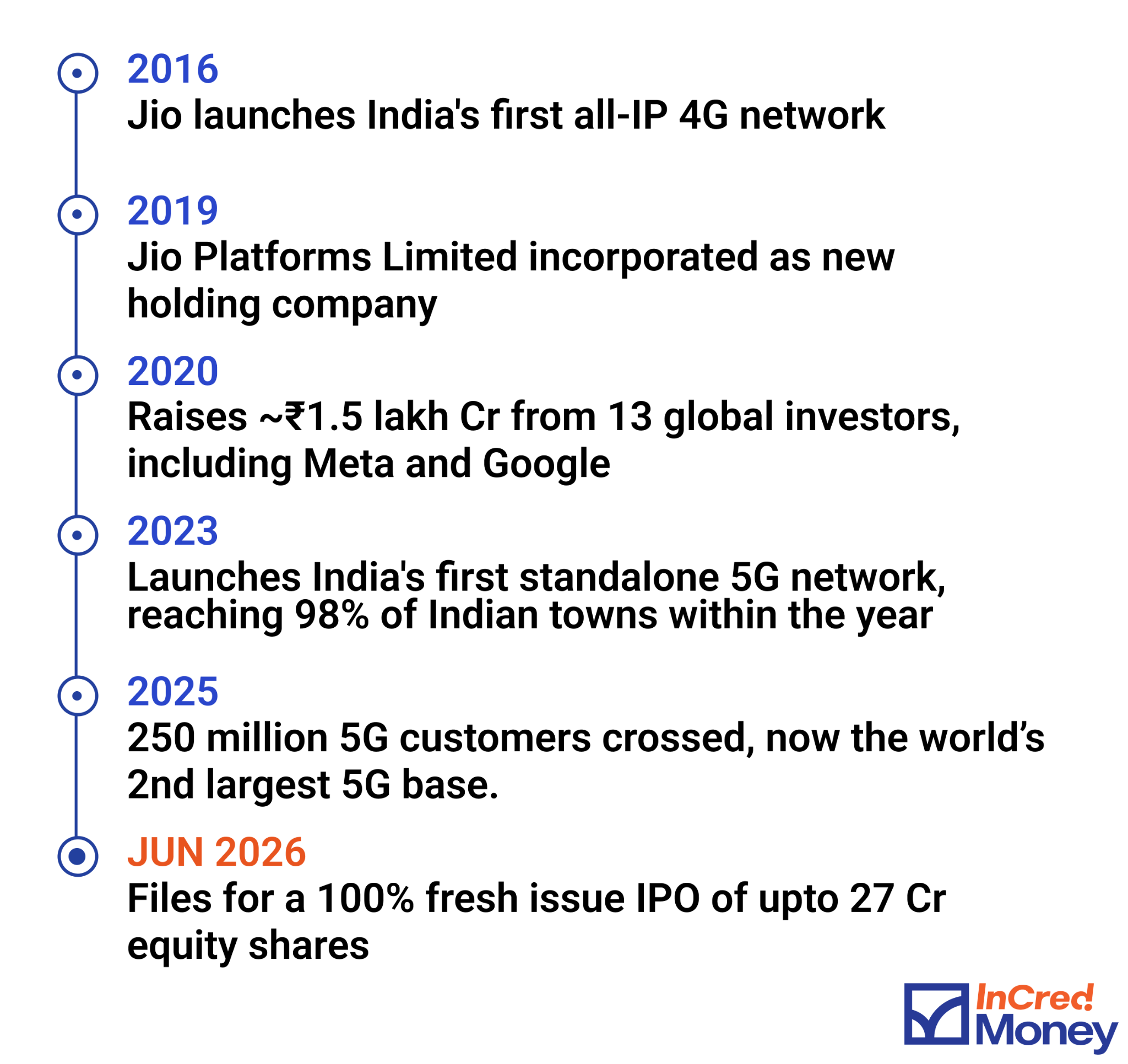
Jio launched perhaps the largest revolution in recent history in 2016, and made going online popular, easy, cheap and sustainable.
Today it carries about 60% of India’s wireless data traffic on a single network. It serves 524.4 million customers, runs the largest 5G network outside China, and has been profitable for years.
Jio Platforms Limited has filed its DRHP on 19th Jun, 2026, for a 100% Fresh Issue, of 270 million shares. It’s backed by Reliance, and global giants like Google, Meta, KKR.
The Jio Timeline
Want to know more about this IPO? Love reading about finance?
Join the InCred Money Insights channel for daily updates on domestic & global markets, plus the latest IPO insights.
Business Model
Jio operates in two big verticals. It provides connectivity via wireless and fixed broadband (think 5G) and also acts as a digital service provider in entertainment, cloud storage and computing solutions (think JioHotstar).
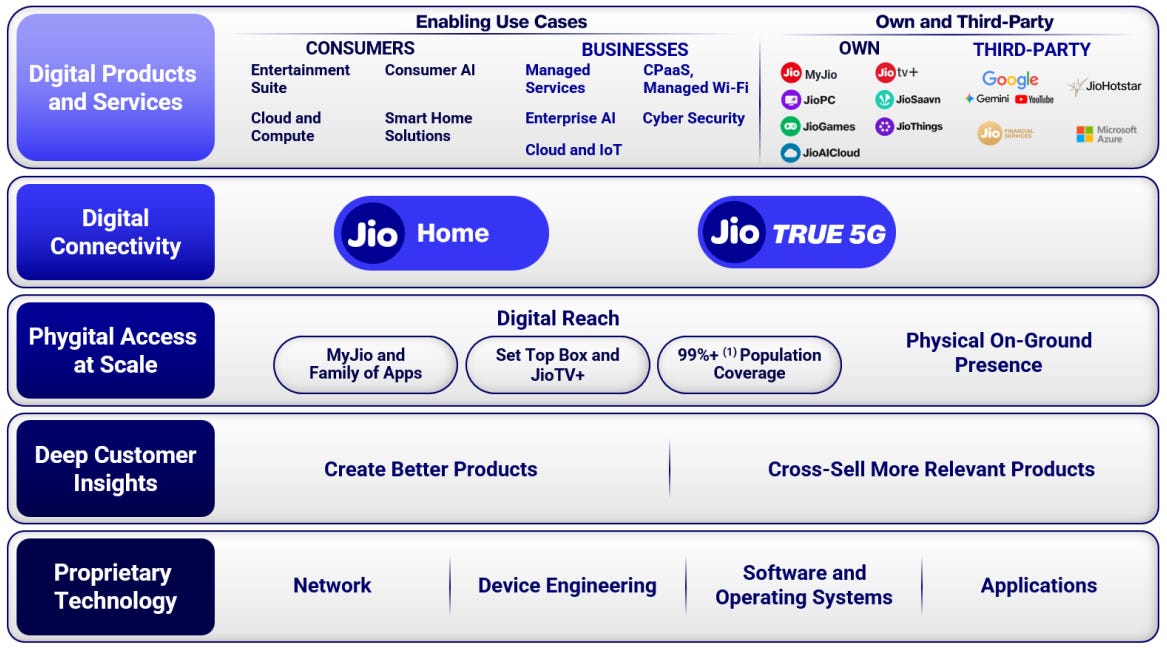
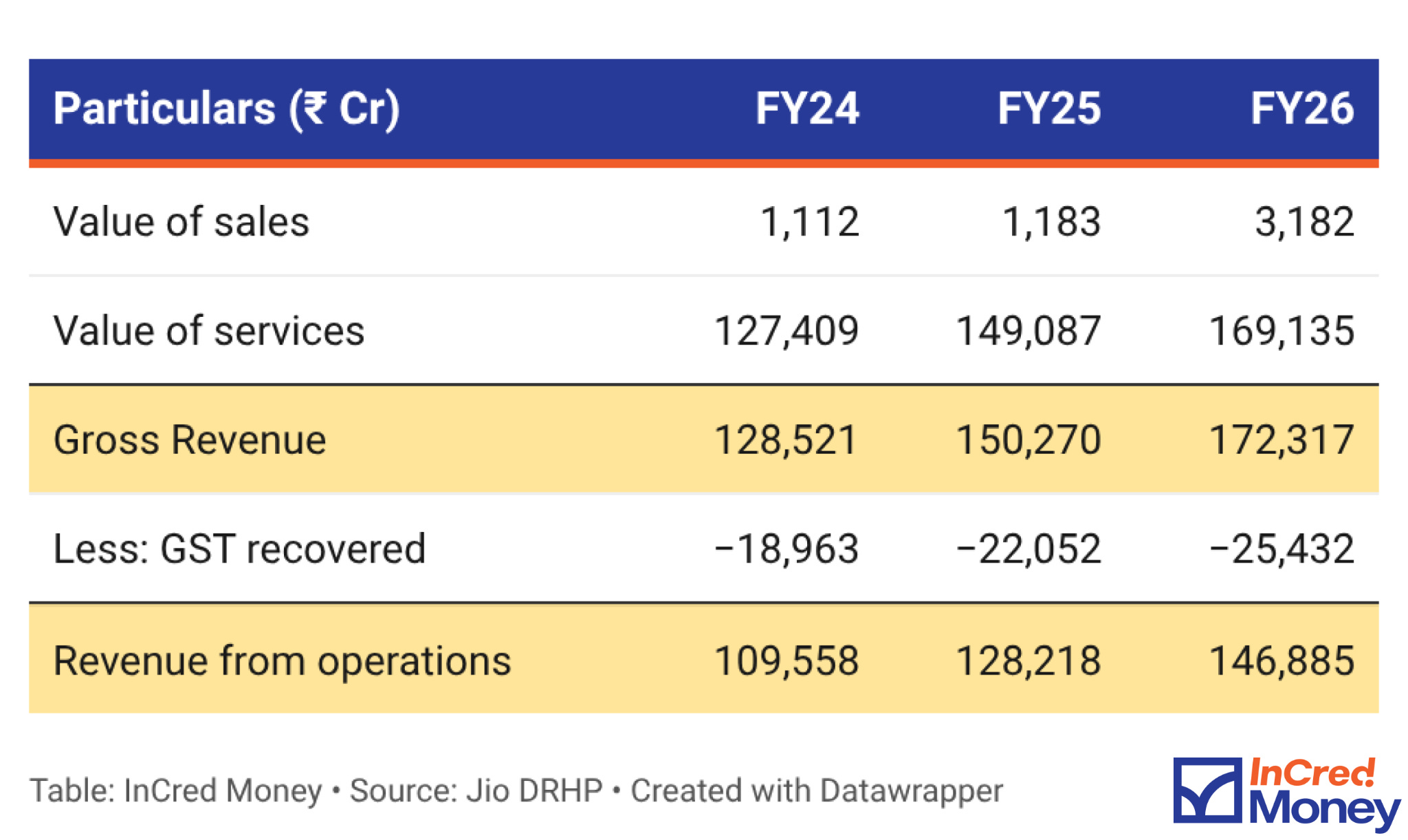
Jio’s Revenue Model
Jio is primarily a service based company. Upon inspecting its revenue model, almost the entirety of its revenue comes from the services it provides, be it data connectivity or entertainment services. Value of sales may include revenue from selling their JioBharat phone or Jio sim cards.
For ABCs on all upcoming IPOs, subscribe to IPOs with InCred Money
Continue reading!
Unit Economics (Per Customer)
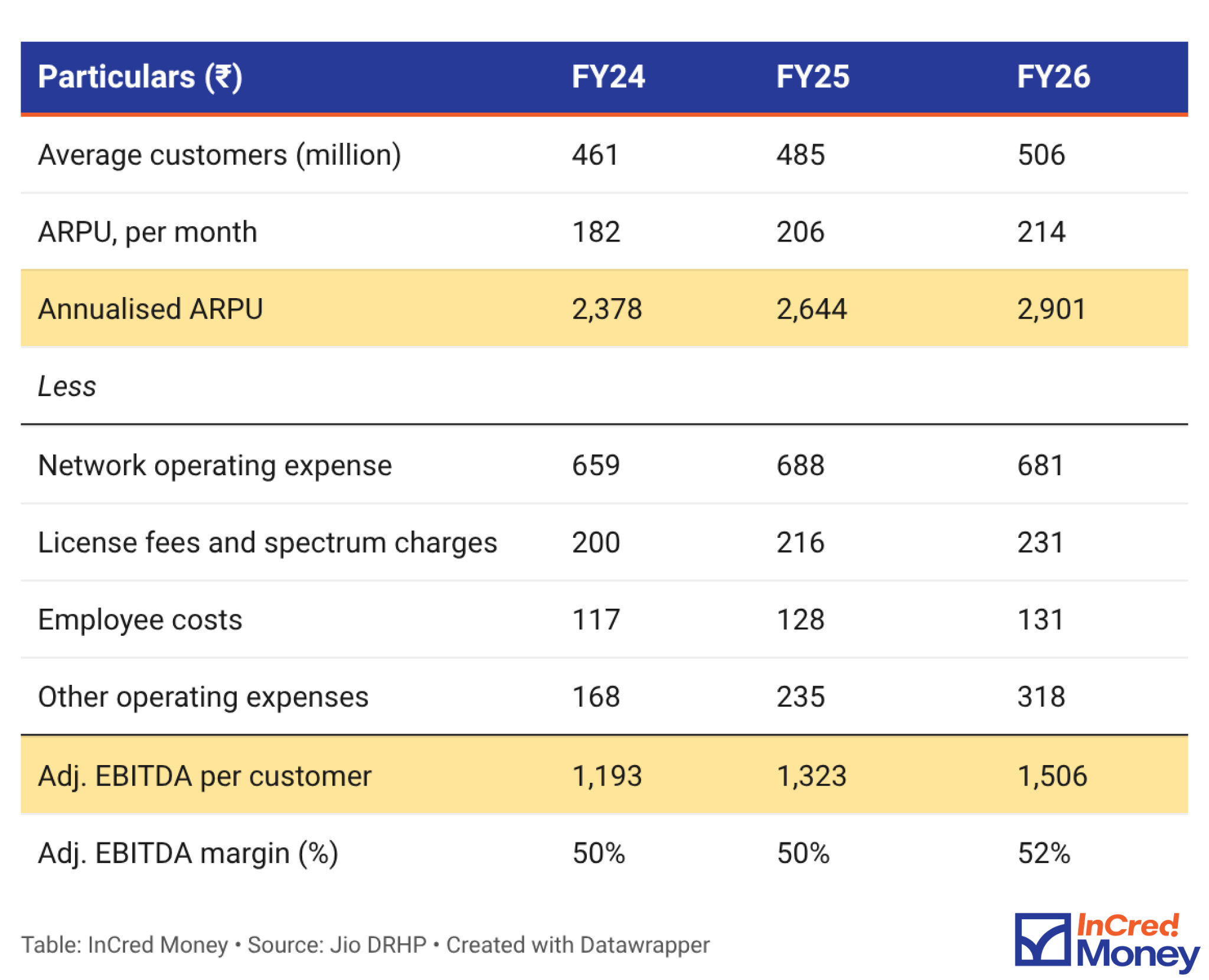
Between FY24 and FY26, the average annual revenue Jio makes from each customer (annualized ARPU) grew strongly, jumping from ₹2,378 to ₹2,901 as its subscriber base grew.
At the same time, daily expenses like network running costs stayed very steady for each user. Because costs stayed low while revenues went up, the money Jio makes per customer has jumped more than 26%, reaching ₹1,506 in FY26.
Operating Metrics
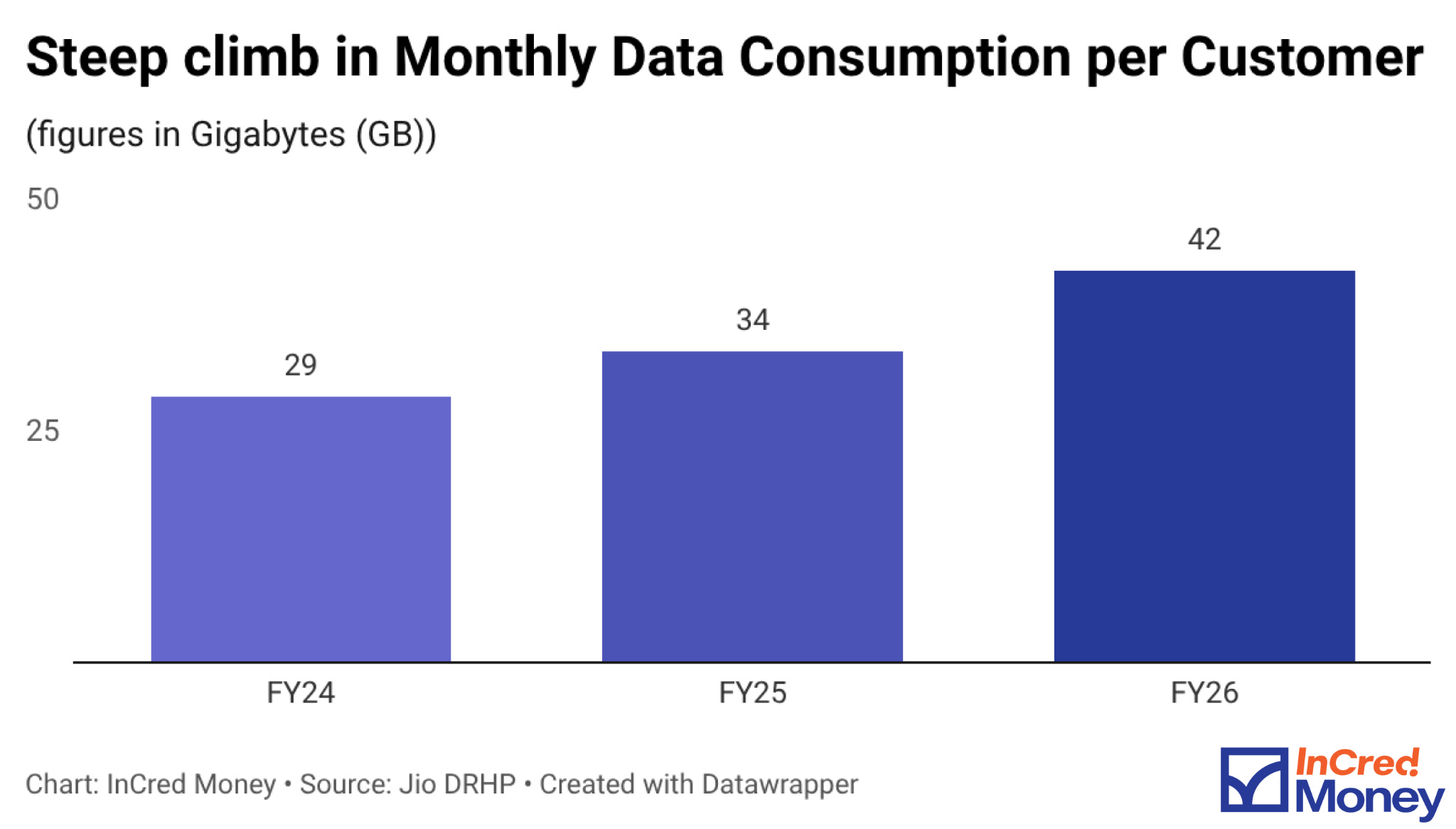
Data Consumption per Customer: Average monthly data usage per customer has surged, climbing from 29 GB/month in FY24 to 42 GB in FY26. The growth is due to the rapid adoption of 5G, as well as the expansion of fixed wireless access, and only further aided by popularity of digital media and streaming services.
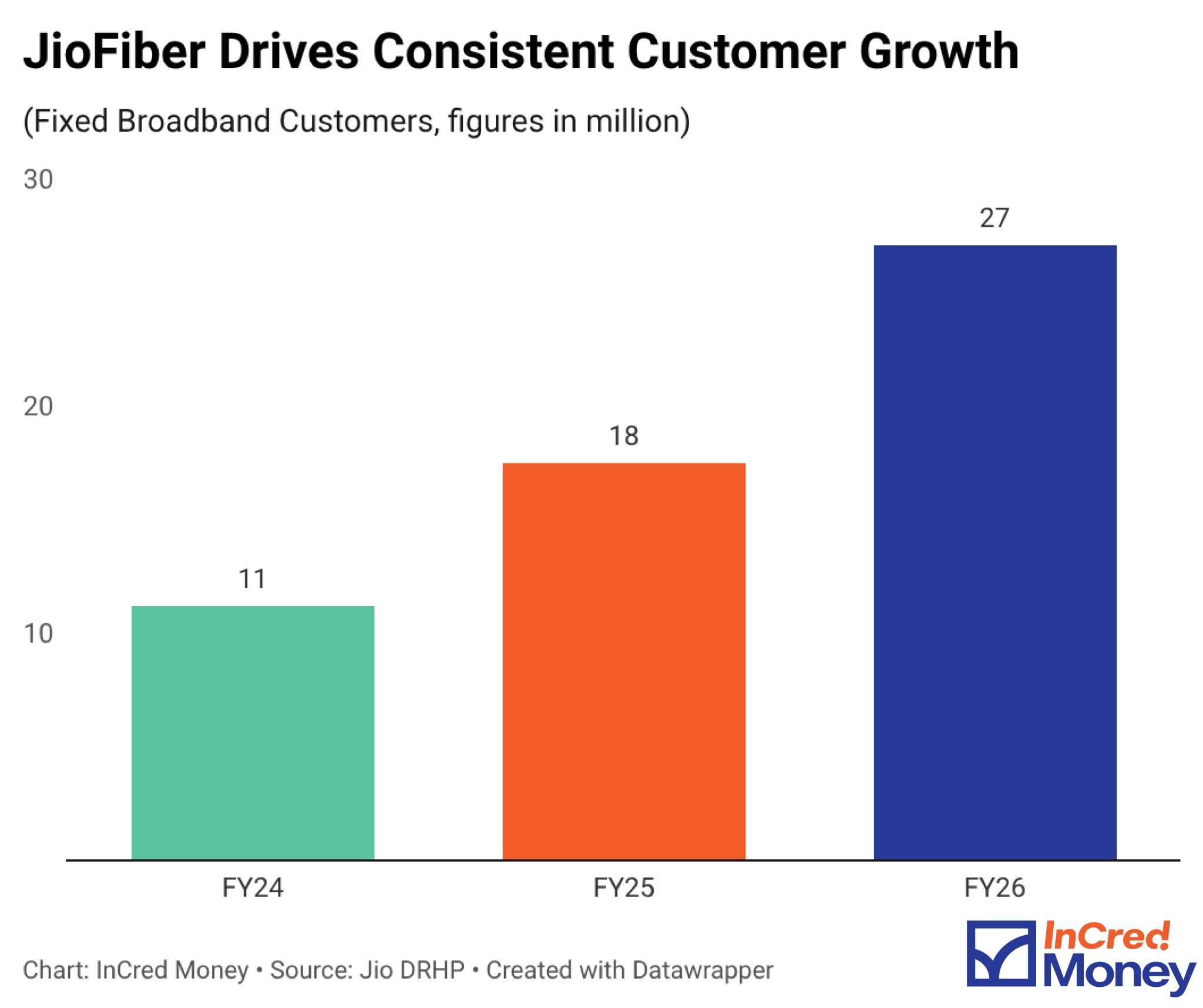
Customer Growth and Mix: Fixed broadband customers increased 11 million in FY24 to 17 million in FY25. Later, in FY26, the expansion of fixed broadband customers rose up to 27.1 million. To summarize this, the fixed broadband customers grew more than 2 times in a span of two years.
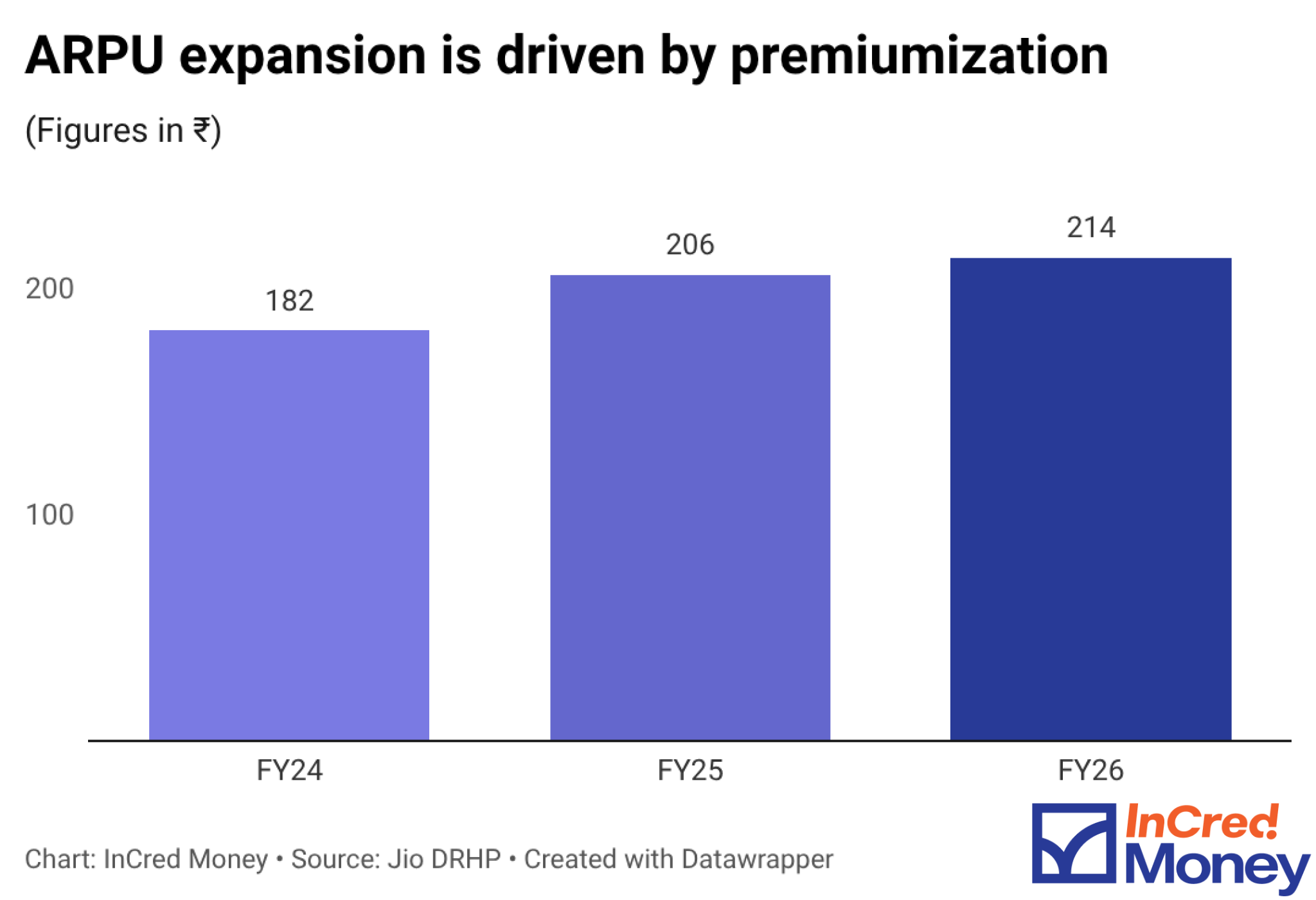
Average Revenue Per User (ARPU): ARPU has grown steadily from ₹182 per month in FY24 to ₹214 per month in FY26, a CAGR of ~9%. OTT platforms like JioHotstar and premium 5G services are key drivers behind people wanting to spend more on the platform. 5G is more expensive, but you pay if the speed is better. This is known as premiumization.
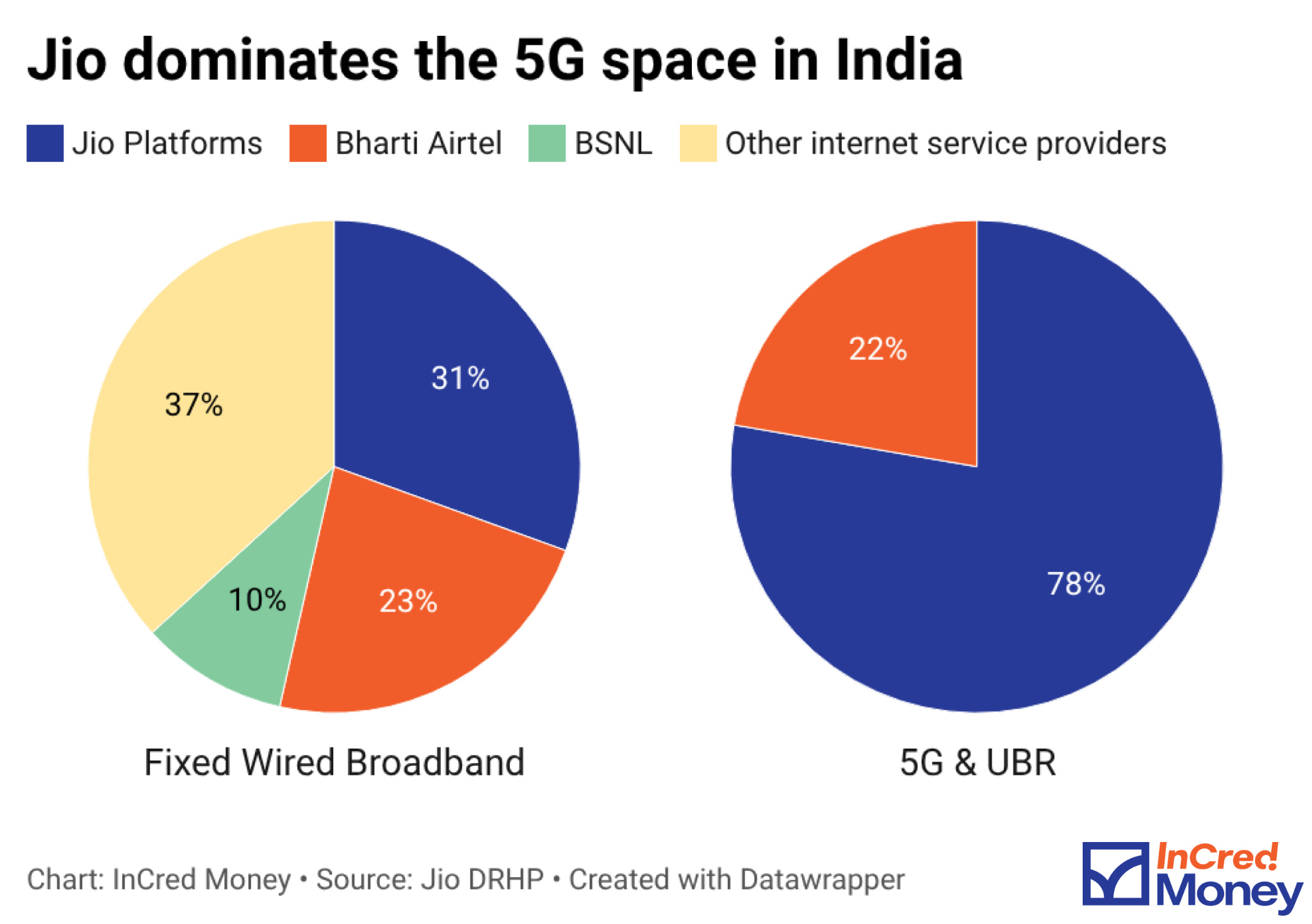
Market Share: Jio commands nearly 78% of the 5G market in India. It is also rapidly taking over the home internet space, carrying ~60% of India’s wireless data traffic in FY26 to secure its position as the undisputed market leader, and now holds a 31% market share in FWB space.
What Jio Is Changing to Improve the Business?
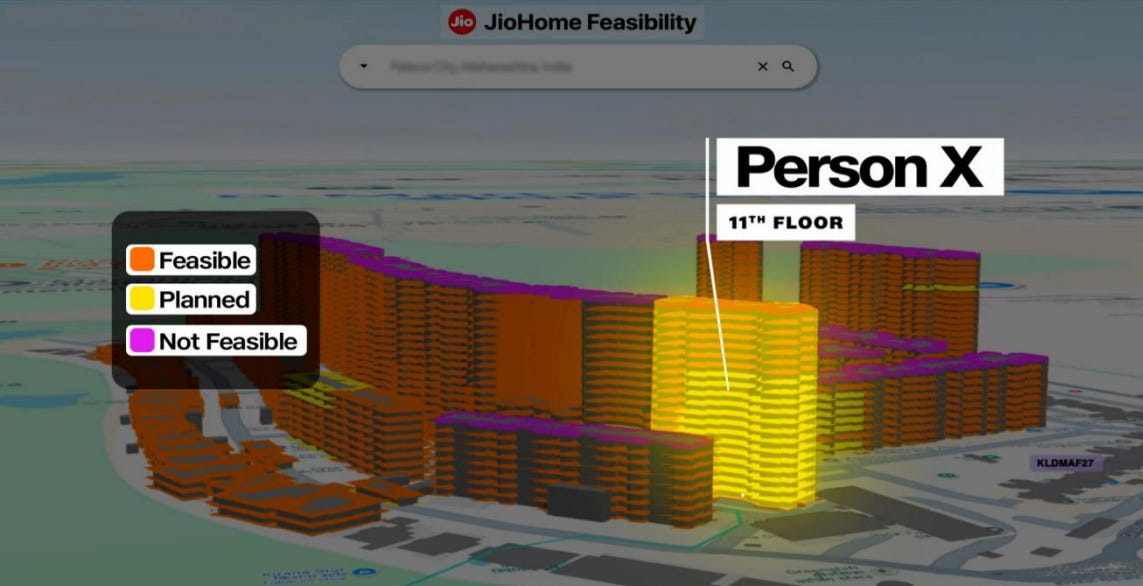
Digital Twin Technology: This technology allows Jio to assess network coverage at any given location in real-time, and thus guide field-engineers for first-time installation at offices and buildings so that the broadband services can be installed efficiently.
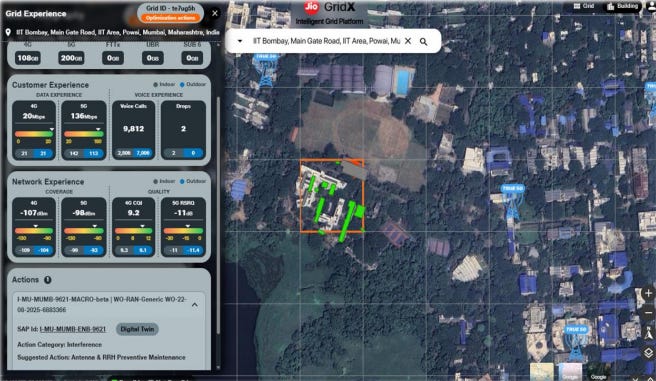
JioGridX: This technology allows Jio to track real-time network data across 82 parameters like speed and coverage, and thus generate automated work orders for field teams and the network operations center so that the customer experience can be continuously and seamlessly improved.
The Financial Stuff
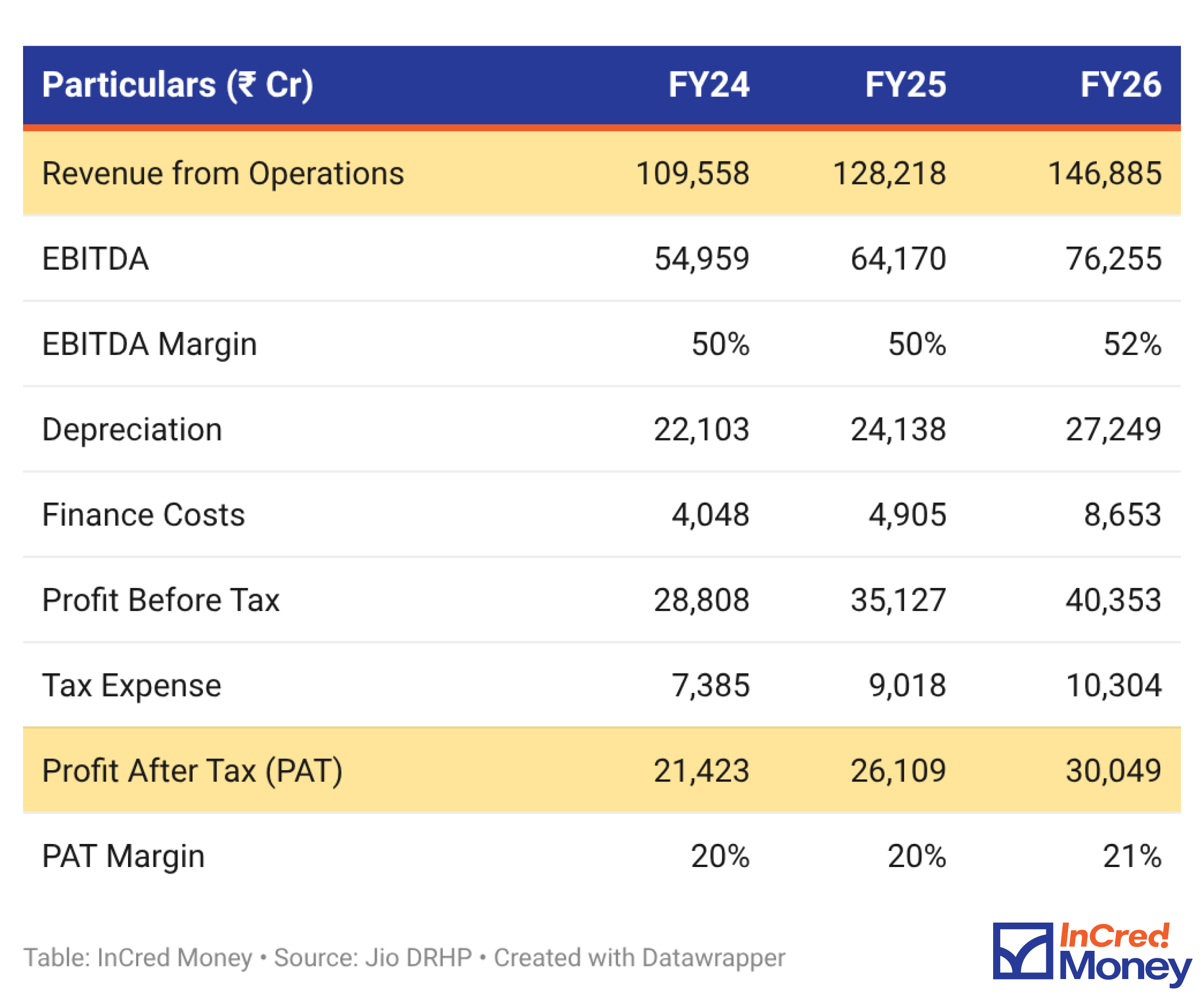
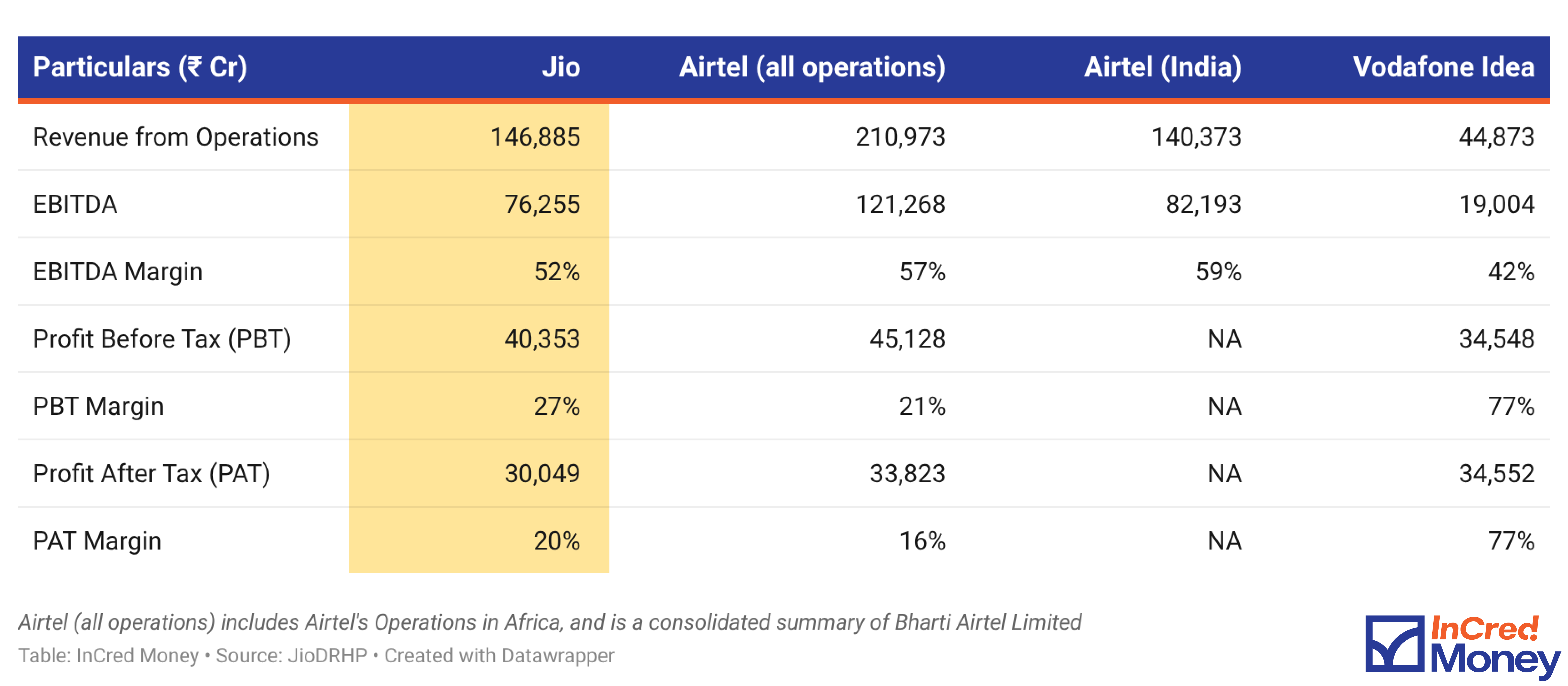
Revenue from operations grew from ~₹1.1 lakh Cr in FY24 to ₹1.47 lakh Cr in FY26, a CAGR of ~16%. This is due to both customer additions and a rising ARPU.
While EBITDA soared, EBITDA Margin only expanded from 50% in FY24 to 52% in FY26, a modest but still meaningful gain.
Profit After Tax rose from ₹21,423 Cr to ₹30,049 Cr over FY24 to FY26. This strong bottom line growth is powered largely by EBITDA gains flowing through despite rising depreciation and finance costs.
Peer Comparison: FY26
Shareholding Pattern
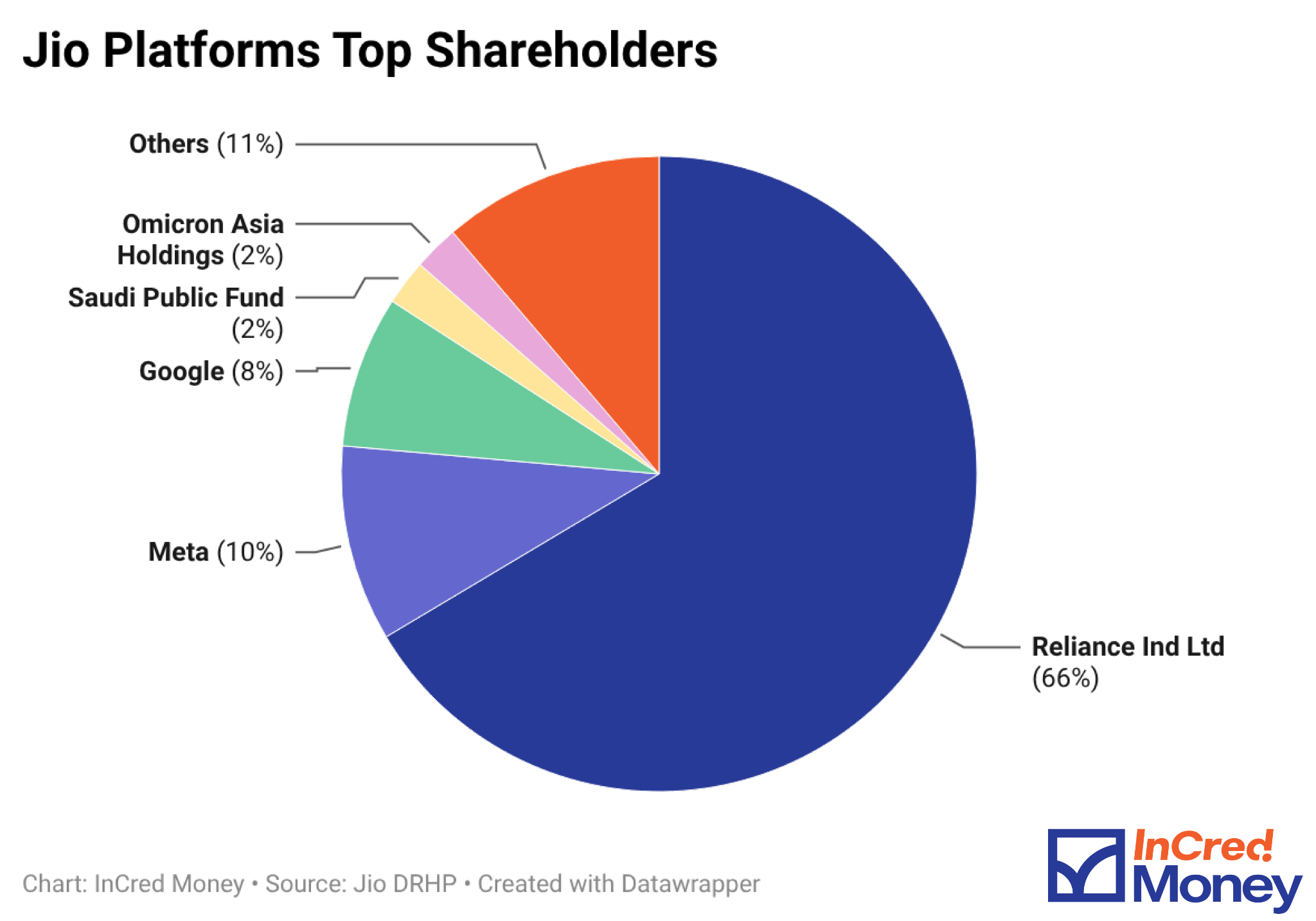
Reliance itself holds roughly 2/3 of Jio. Jio also has a lot of investment coming from foreign entities like the Saudis’ Public Investment Fund, as well as Google.
Key Risks
High Spending on Technology: Building and upgrading networks like 5G requires a massive amount of upfront money. While the main 5G network is mostly built, the company must keep spending to upgrade its technology. If Jio cannot successfully get customers to pay more for these faster speeds, it will hurt the company’s overall returns.
Government Rules and Regulations: The telecom industry is strictly monitored by government authorities. New rules—like India’s recent data privacy laws—require the company to change how it handles customer information. Following these changing laws could increase Jio’s daily running costs and create extra paperwork.
Relying on One Main Business Partner: Jio depends heavily on Reliance Retail to sell its prepaid plans, sign up new customers, and collect payments. Because it relies so much on this single partner company, any issues or changes in their agreement could quickly hurt Jio’s customer growth and sales network.
High Costs for Apps and Cloud Services: Jio is spending a lot of money on content, entertainment, and data centers to become more than just a mobile network. If customers do not buy premium apps or if businesses do not adopt Jio’s AI tools as quickly as expected, these high costs will eat into profits.
Summary
Jio Platforms will enter the market as a telecom giant, not a growth story. None of its 2020 private investors, Meta, Google, or the Sovereign and PE funds, will sell any shares. Of the fresh issue proceeds, ₹27,500 Cr are earmarked repayment of borrowings taken on by its subsidiary RJIL.
Disclaimer
This content is based on publicly available information contained in the Draft Red Herring Prospectus (DRHP) and is intended solely for educational and informational purposes. It should not be construed as investment advice, recommendation or solicitation to invest.
Any video/image/text content is for educational and informational purposes only and does not constitute financial advice. Please do your own research or consult a qualified financial advisor before making any investment or trading decisions. Trading in stock markets involves the risk of loss.
Investments in the securities market are subject to market risks, read all the related documents carefully before investing. Brokerage will not exceed the SEBI prescribed limit.
InCred Money Broking Limited : NSE Member Code 09073, BSE Member Code 6329, MCX Member Code: 55215 , NCDEX Member Code : 1233 NSDL : IN-DP-474-2020 . SEBI Registration No. NZ000164738
Compliance Officer: NSE,BSE,MCX,NCDEX,NSDL : Mr RK Jain,011-40409999 support@stocko.in
Registered Office:- 3rd Floor, Building No.5, Local Shopping Complex, Rishabh Vihar, Near Karkarduma Metro Station. East Delhi – 110092
Source: Draft Red Herring Prospectus (DRHP) of Jio Platforms Limited